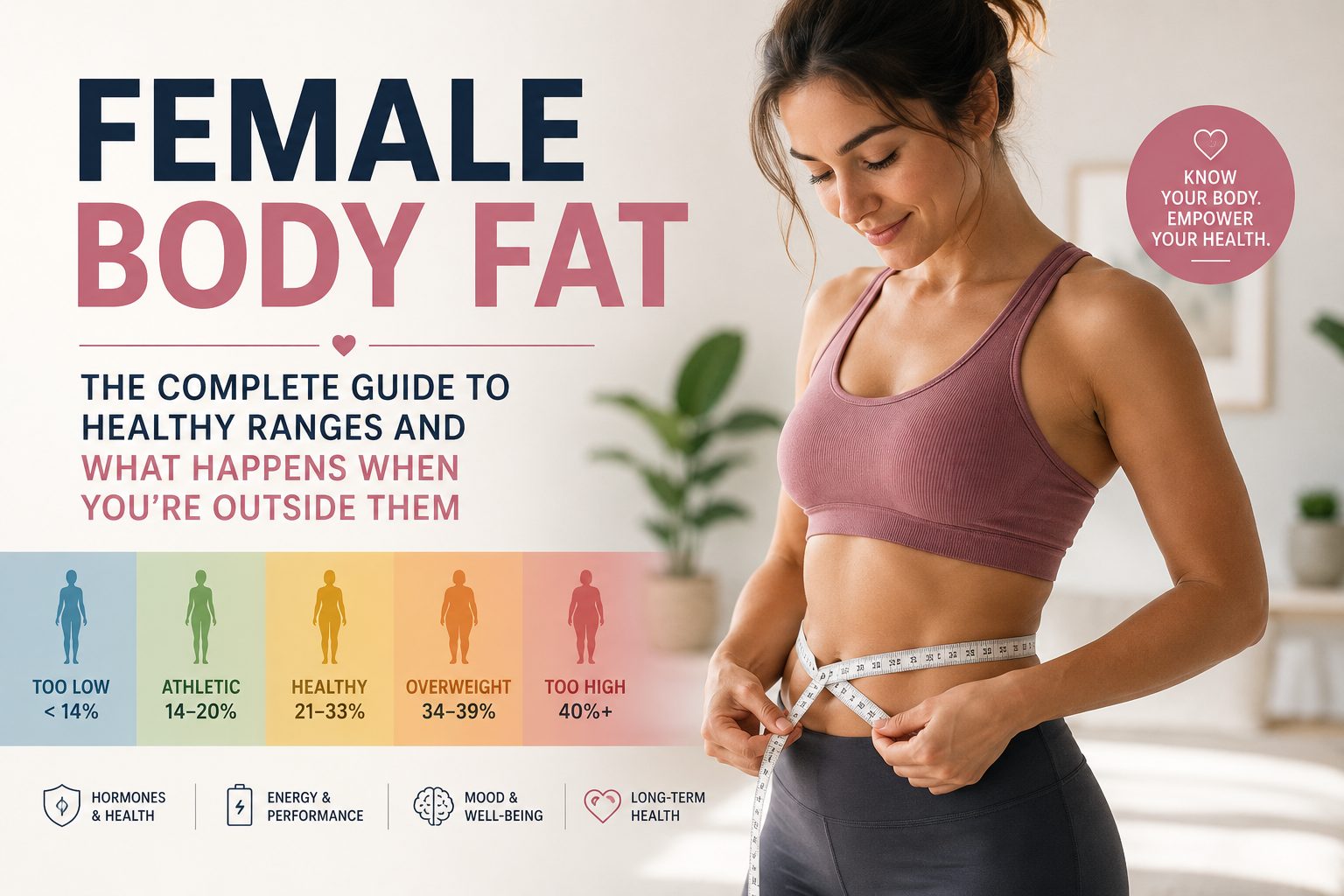
Body fat is not the enemy – it is an active, hormone-producing tissue that keeps your brain, cycle, and metabolism running. The problem arises when levels drift too far in either direction.
What Are Healthy Ranges for Women?
The American Council on Exercise (ACE) classifies female body fat into four key categories:
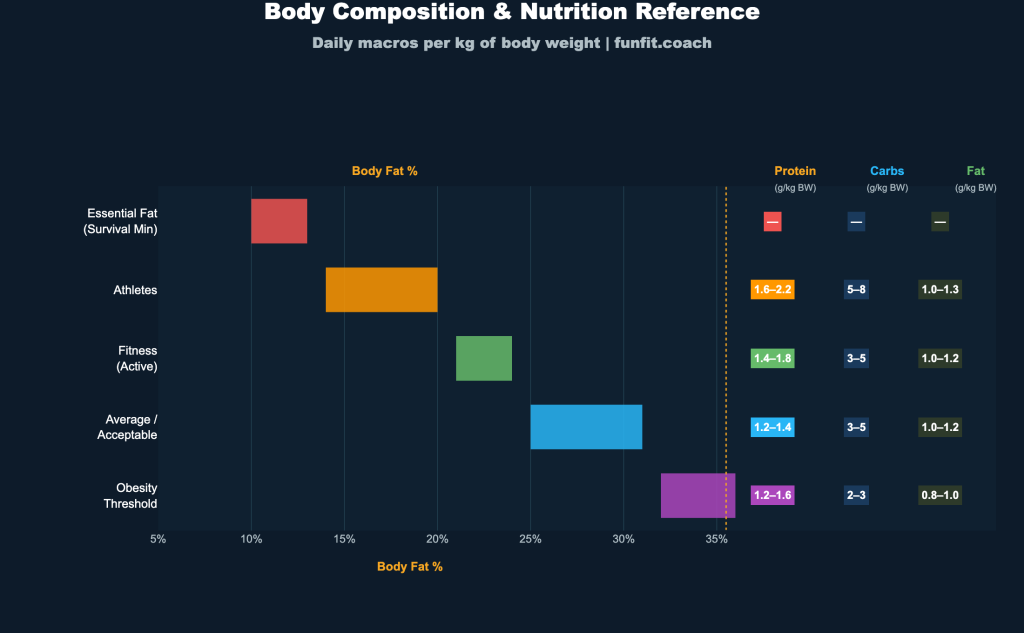
| Category | Body Fat Range | Daily Protein | Daily Carbs | Daily Fat |
| Essential fat (survival minimum) | 10–13% | — | — | — |
| Athletes | 14–20% | 1.6–2.2 g/kg BW | 5–8 g/kg BW | 1.0–1.3 g/kg BW |
| Fitness (active, healthy) | 21–24% | 1.4–1.8 g/kg BW | 3–5 g/kg BW | 1.0–1.2 g/kg BW |
| Average/acceptable | 25–31% | 1.2–1.4 g/kg BW | 3–5 g/kg BW | 1.0–1.2 g/kg BW |
| Obesity threshold | ≥32% | 1.2–1.6 g/kg BW | 2–3 g/kg BW | 0.8–1.0 g/kg BW |
Essential Fat (10–13%) – No Macro Targets Apply
This is not a goal category – it is a physiological red zone. At this level, the body has entered a survival state: estrogen production collapses, the menstrual cycle stops, thyroid output drops, and bone resorption accelerates faster than new bone can form. Fat-soluble vitamins A, D, E, and K can no longer be properly absorbed or stored, and immune function becomes severely compromised.
No healthy macro protocol exists for maintaining 10–13% body fat in women. If a woman reaches this threshold – whether through extreme dieting, disordered eating, or excessive training load without adequate fueling – the clinical priority is immediate nutritional restoration, not optimization.
The recovery protocol should emphasize:
Protein: ≥1.6 g/kg BW to halt lean mass breakdown and support hormonal rebuilding
Dietary fat: ≥1.0–1.2 g/kg BW – fat is the direct substrate for estrogen, progesterone, and leptin synthesis; it cannot be restricted during recovery
Carbohydrates: ≥3–5 g/kg BW to restore thyroid function, normalize cortisol, and replenish glycogen
Total caloric surplus above maintenance until the menstrual cycle resumes – cycle return is the primary marker of recovery, not a number on a scale or DEXA scan
These ranges also shift slightly with age – women in their 20s optimally sit around 20–31%, while women 60+ may naturally carry 25–35% without health consequences. The key threshold to remember: dropping below 10–13% is physiologically dangerous, regardless of age or sport.
Body Fat by Occupation and Sport
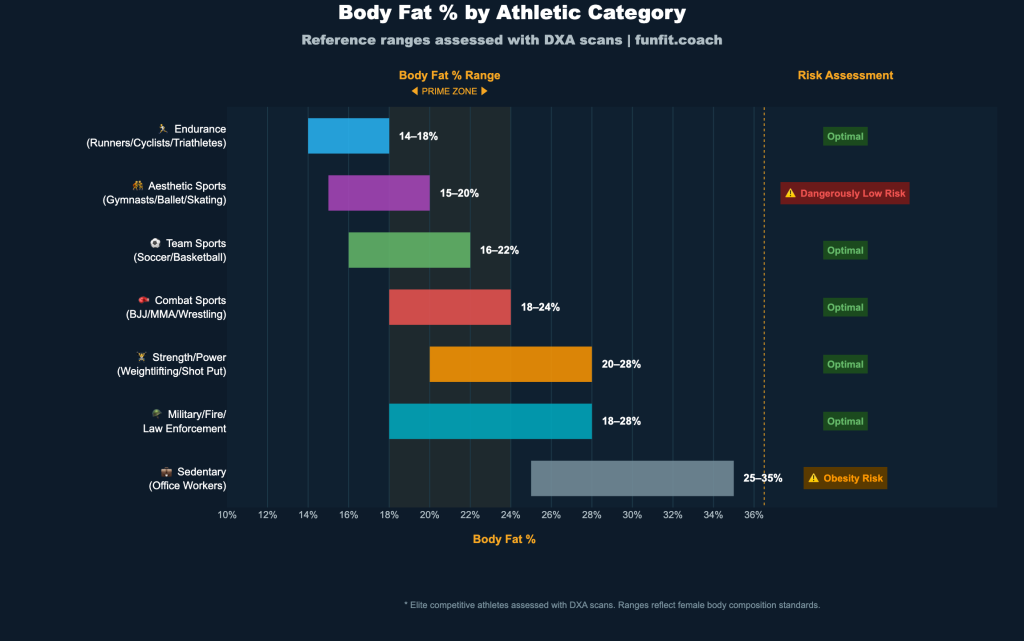
Different lifestyles and sports demand very different compositions:
- Endurance runners, cyclists, triathletes: 14–18%
- Gymnasts, ballet dancers, figure skaters: 15–20% (at high risk for dropping dangerously low)
- Team sport athletes (soccer, basketball): 16–22%
- Combat sport athletes (BJJ, MMA, wrestling): 18–24%
- Strength/power athletes (weightlifting, shot put): 20–28%
- Sedentary office workers: 25–35%
- Military/firefighters/law enforcement: 18–28%
Elite competitive athletes assessed with DEXA scans show a practical lower limit of approximately 16% body fat for females during active competition.
DEXA (Dual-Energy X-Ray Absorptiometry) is the clinical gold standard for body composition tracking. Unlike standard scales, it uses ultra-low-dose X-ray technology to directly measure and differentiate body fat, lean muscle mass, and bone density with unmatched accuracy.
The Dangers of Too Little Body Fat
Menstrual Cycle and Hormones
When body fat falls below roughly 13%, the brain perceives a starvation signal and suppresses the hypothalamic-pituitary-ovarian (HPO) axis. This halts the pulsatile release of GnRH, which in turn drops FSH and LH – halting ovulation and estrogen production. The result is hypothalamic amenorrhea (HA): the loss of the menstrual cycle. This is not a minor inconvenience — it is a full endocrine emergency.
Metabolism and Energy
With HA comes a sharp metabolic slowdown. The body reduces thyroid hormone output and resting metabolic rate to conserve fuel. Low leptin levels – the hormone secreted by fat cells that signals energy availability – disrupt appetite regulation, reproductive signals, and immune function simultaneously.
Bone and Brain Function
Estrogen deficiency from low fat triggers bone resorption faster than new bone can form, accelerating osteoporosis and stress fracture risk. Cognitively, low estrogen impairs memory, mood regulation, and concentration. Athletes with HA frequently report brain fog, depression, and sleep disorders alongside their missing period.
Micronutrient Absorption
Fat-soluble vitamins – A, D, E, and K – require dietary fat and adequate adipose tissue to be absorbed and stored. Women with very low body fat face impaired absorption and storage of these vitamins, compounding bone loss (vitamin D and K), immune dysfunction (vitamin A), and oxidative stress (vitamin E).
The Dangers of Too Much Body Fat
Endocrine Disruption
Excess adipose tissue, particularly visceral fat (around the organs), functions as a rogue endocrine gland. It converts androgens to estrogens via aromatase, creating an estrogen excess that disrupts the menstrual cycle from the opposite direction. This is a core driver of PCOS, endometrial hyperplasia, and infertility.
Metabolism and Insulin Resistance
High body fat – especially visceral fat – floods the liver and muscles with excess free fatty acids, driving insulin resistance and dyslipidemia. This increases the risk of type 2 diabetes, metabolic syndrome, and cardiovascular disease.
Vitamin D Sequestration
Ironically, high body fat also impairs vitamin D status – but for a different reason. Excess adipose tissue sequesters vitamin D, pulling it out of circulation and making it biologically unavailable. Obese women often need significantly higher supplementation doses to reach adequate serum levels.
Brain Function
Chronic inflammation from high visceral fat crosses the blood-brain barrier, linked to increased risk of cognitive decline, depression, and reduced neuroplasticity.
The Bottom Line
For most women, staying within 18–28% body fat covers both health and performance without tipping into the danger zones on either end. Athletes can safely operate in the 14–20% range, provided their menstrual cycle remains regular – which is the single most important biofeedback signal your body sends about whether your fat levels are truly sustainable.